





By Catherine Bischofberger, 7 July 2026
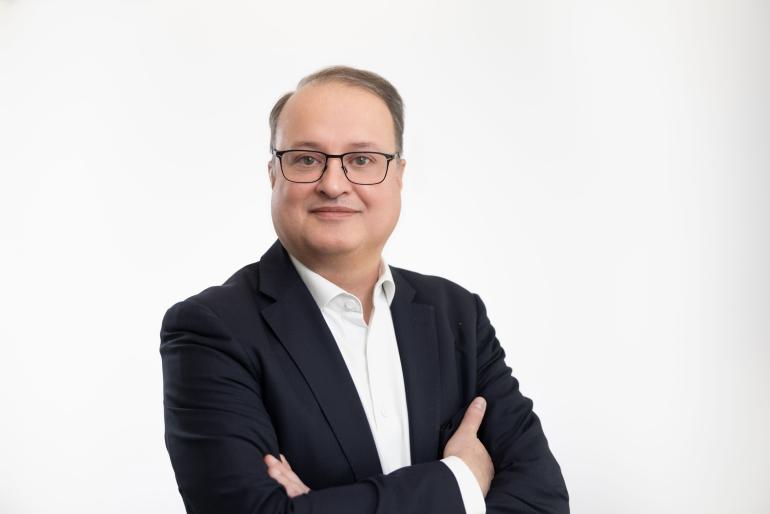
Gilles Nativel is the Chair of IEC TC 57, a core technical committee in the IEC, best known for standardizing many of the technologies used in the smart grid. In this in-depth interview, he tells e-tech how artificial intelligence (AI) is changing the work of his experts.
How would you describe the work of the experts inside TC 57?
TC 57 has been at the heart of power systems’ digitalization for decades. We develop core standards enabling communication between power systems and equipment, such as the IEC 61850 series as well as the CIM – or common information model – standards, the IEC 61970 series, which allow system level information and data exchange. We also develop IEC 62325, which is a fundamental series defining the framework for market energy communications. All these standards allow grid protection systems, substations, control centres and market platforms to work together in a consistent and interoperable way. Our scope is wider than that. Our standards also address critical areas such as control and automation, system integration across transmission and distribution networks as well as cyber security for power system communications, through IEC 62351. We really provide the digital backbone of power systems.
What are your main priorities as Chair?
My first priority is to ensure that all our standards continue to support the transformation of the power grid. We are moving from relatively stable engineering-driven systems to increasingly interconnected, digital and data-driven ones. In such a context, interoperability is more critical than ever. If these different devices and systems do not understand each other and seamlessly exchange information, then they simply cannot operate efficiently. Another important priority is to make our standards more digital friendly, which means we need to make them easier to use but also machine-readable. This implies that they should no longer only be read by engineers but increasingly by software and AI systems.
How will AI impact the grid and how do TC 57 Standards address it?
AI is already impacting the grid and this will accelerate. It brings new capabilities for operators and vendors and enables them to do things which were previously impossible to achieve. For example, AI enables grid operators to anticipate failures before they happen. Operators can optimize the system in real time and use much more advanced analysis. But AI also changes the way decisions are made. Traditionally, power systems were deterministic. Operators knew by and large how they behaved. AI brings a degree of uncertainty, and power systems are now evolving in a more probability-driven environment, with results that are sometimes not fully explainable. Another important shift is that in the past, humans were making and validating decisions. In the future, more and more decisions will be taken automatically, while humans will be supervising the systems. In simple terms, we are moving from operator-driven systems to intelligent systems, supervised by humans. This is a tremendous change which we have to take into account in our standards. And this is no mean feat, because it is not a matter of simply adding new features, it is revolutionizing the way we have think about our standards.
In which ways?
Firstly it totally changes the nature of the data we handle. We are no longer dealing with deterministic values but with probabilities, forecasts and uncertainty. Secondly, it requires us to not only standardize data exchanges, as we already do, but interaction with AI models, which is a very complex task. Thirdly, it has an impact on engineering itself. For example, in IEC 61850, we use what we call structured configuration files, SCLs, which describe systems in a machine readable way, suited for automation. This could be used by AI to support engineering and evaluation of the systems. This means we can probably expect AI to support the design and engineering of power systems and the validation process of their overall configuration. TC 57 Standards are therefore evolving from supporting the interoperability of power devices and systems to supporting the interoperability of intelligent data-driven ecosystems and AI will have an increasingly big role to play.
How do TC 57 Standards address predictive maintenance (PM) for the grid?
Predictive maintenance is not standardized as an application in TC 57 Standards. However, our documents provide the essential backbone for PM with data models and communication standards and the integration frameworks behind it all. These allow systems to collect and exchange high quality data about assets, which is exactly what AI needs to perform PM. TC 57 makes PM possible in an indirect way by making data usable, interoperable and accessible.
What are the main challenges for TC 57, moving forward?
I would say the main one is dealing with the increasing complexity of power systems. They are becoming more decentralized, dynamic and interconnected. At the same time the technologies we have to integrate are evolving rapidly – it is not only AI, but also cloud storage and digital platforms, more generally. We tread a fine line between having to adapt rapidly to ensure we remain relevant and avoid creating fragmentation or losing coherence. Another important challenge, which is one of our core values, is maintaining trust. As systems become more automated and data-driven, ensuring cyber security and data integrity becomes crucial. If you can’t trust the data, you can’t operate the grid. And with the integration of AI, cyber security becomes even more of an issue.
What areas are you looking to standardize in coming years?
We are developing standards on configuration and engineering frameworks. The idea is to address how to configure and define the tools for the design of power systems and we have a group working on these standards. We also have an important project on the virtualization of power systems, which is a demonstration of IT and OT convergence. We are also developing a standard enabling the remote maintenance of power systems. I will equally mention new cyber security standards – this area is never-ending! We are looking at quantum technology and how it affects cyber security, for instance.
Lastly, we are looking at the interface of power systems with distributed energy systems (DERs), including e-mobility devices and smart homes. To do this, we have formed a joint group with IEC TC 13, which standardizes smart metering systems and SC 23K, a subcommittee which notably works on energy efficient systems for smart buildings. Enabling flexibility of the grid is a key concern. In the longer term, new trends and areas of standardization are of course the integration of AI in power systems, how to represent the results of AI, how to deal with uncertainty and how to interface AI systems with operational systems in a safe and interoperable way. Another important trend is the move towards data-centric architectures, which deal with continuous large volumes of data as well as cloud and edge computing. Our scope is expanding from electrical systems to data-based and increasingly intelligent systems. We are a foundational block of the all-electric and connected society and in that way we are a strategic and central committee for the IEC. We therefore have an obligation to succeed.
Will you be working with ISO/IEC SC 42, which prepares standards for AI?
There is a growing need for closer collaboration and alignment. This committee provides horizontal expertise on AI while TC 57 brings deep knowledge of power systems. We don’t want to duplicate work. We need to better understand what ISO/IEC SC 42 is doing and see how their standards can be adapted to critical infrastructure such as power systems. The cooperation could be through a joint working group or through the Systems Committee for Smart Energy (SyC Smart Energy), which we are part of. We will be taking part in the IEC General Meeting in Hamburg and will possibly organize a workshop with SC 42 experts to examine the risks and opportunities of AI.
How do you unwind?
I recently became a grandfather and looking after my grandchild usually does the trick!
Gilles Nativel joined the R&D arm of EDF in 1993, working on power system operation and simulation. He then moved to transmission (RTE), focusing on grid connection frameworks, before joining the distribution side (Enedis) in 2001. He held several senior operational roles in regional network management, and since 2014 has been based at Enedis headquarters. He is currently Head of Standardization and Intellectual Property within the R&D, Strategy and Innovation Division. As Enedis’ Standardization Delegate, he leads the company’s strategy on standardization for smart grids and represents Enedis in international governance bodies. He notably served as President of the French IEC National Committee and as a member of the IEC Board (2019–2025). He is currently the Chair of IEC TC 57. He is also Chair of Eurelectric’s Sustainable Network Technology Committee. He graduated from École Centrale in Paris and holds a Master of Science in Electricity Distribution Management from the University of Bordeaux.
 Archivio Numeri